Showing posts with label project. Show all posts

Tuesday, June 22, 2010

PIC based Animation Tile Display

PIC based Animation Tile Display, Display, LED, project, PIC, PIC24FJ64GA002, animation, puzzle
Puzzlemation is an expandable platform of light and animation based on PIC24FJ64GA002. It can be used to create things as diverse as modular animated signs that can be changed by rearranging its tiles, to a uniquely animated puzzle. This project’s display is made of a number of tiles, about 2 inch square with an 8 x 8 array of color LED pixels. Each tile is individually powered and animated, so user can freely pick them up and re-arrange them. To set up a display, the tiles are placed in a special tray. Animations are downloaded into the tray via Ethernet and stored locally on an EEPROM, or loaded via an SD card. The tray broadcasts the animation to each of the tiles, and then synchronizes them.

John Peterson, project designer, said that the display is completely reconfigurable. If the pieces are left in the tray, the animation can be updated continuously over the Ethernet connection. If the tiles are removed from the tray, they’ll display the animation for several hours with their own re-chargeable battery power. Once the animation is synchronized and running on the tiles, user can pick them up and place them anywhere.

Download:
Project Documentation, Source Code and Schematic(zip)
tag :
Display, LED, project, PIC, PIC24FJ64GA002, animation, puzzle

Monday, October 5, 2009

AVR Digital Clock with Roman Numerals


This digital clock project will display a Roman number instead Hindu-Arabic numeral system (1,2,3... ). The project uses micro ATTINY2313 as main processor and LCD to display the clock. When you turn on the device, it will shows a screen flashes "Tempera tempus" as reminder to adjust the time.


The adjustment is done via the small button.
  • Press and hold the button for about 3 seconds -> hours appear on the screen -> release the button.
  • Press the button again and hold -> the hours advance from "I" to "XXIV" -> release the button on the time right.
  • Wait about 3 seconds -> minutes to appear on the screen.
  • Press the button and hold -> the minutes advance from "nothing" to "LIX" -> release on just minutes.

    Unfortunately, you have to readjust the time after your turn off the power, because there is no RTC in this  project.

    Download schematic and source code here

    Thursday, September 17, 2009

    Simple PIC RF/Microwave Frequency Counter

    PIC RF/Microwave Frequency Counter
    This RF/Microwave Frequency Counter project built based on PIC 16F876A. The basic counter rate is extended to at least 180MHz using two 74Fxx devices. A divide-by-64 prescaler is used for higher frequencies up to at least 4.5GHz. All results of the measurement are shown on an inexpensive, 2x16 alphanumeric LCD module with large characters.

    There are 3 inpust on this project a microwave (prescaled) input, an RF input and a TTL input. The microwave and RF inputs are AC coupled and terminated to a low impedance (around 50ohms). The TTL input is DC coupled and has a high input impedance. A progress-bar indicator is provided on the LCD for the gate timing.

    Both the microwave and RF inputs have an additional feature : a simple signal-level detector driving yet another bar indicator on the LCD module. This is very useful to check for the correct input-signal level as well as an indicator for circuit tuning or absorption-wave-meter dip display (Lecher wires). This project designed by Matjaz Vidmar.

    tag : RF counter, Microwave Frequency counter, PIC project source

    Simple PIC RF/Microwave Frequency Counter

    PIC RF/Microwave Frequency Counter
    This RF/Microwave Frequency Counter project built based on PIC 16F876A. The basic counter rate is extended to at least 180MHz using two 74Fxx devices. A divide-by-64 prescaler is used for higher frequencies up to at least 4.5GHz. All results of the measurement are shown on an inexpensive, 2x16 alphanumeric LCD module with large characters.

    There are 3 inpust on this project a microwave (prescaled) input, an RF input and a TTL input. The microwave and RF inputs are AC coupled and terminated to a low impedance (around 50ohms). The TTL input is DC coupled and has a high input impedance. A progress-bar indicator is provided on the LCD for the gate timing.

    Both the microwave and RF inputs have an additional feature : a simple signal-level detector driving yet another bar indicator on the LCD module. This is very useful to check for the correct input-signal level as well as an indicator for circuit tuning or absorption-wave-meter dip display (Lecher wires). This project designed by Matjaz Vidmar.

    tag : RF counter, Microwave Frequency counter, PIC project source

    Simple PIC RF/Microwave Frequency Counter

    PIC RF/Microwave Frequency Counter
    This RF/Microwave Frequency Counter project built based on PIC 16F876A. The basic counter rate is extended to at least 180MHz using two 74Fxx devices. A divide-by-64 prescaler is used for higher frequencies up to at least 4.5GHz. All results of the measurement are shown on an inexpensive, 2x16 alphanumeric LCD module with large characters.

    There are 3 inpust on this project a microwave (prescaled) input, an RF input and a TTL input. The microwave and RF inputs are AC coupled and terminated to a low impedance (around 50ohms). The TTL input is DC coupled and has a high input impedance. A progress-bar indicator is provided on the LCD for the gate timing.

    Both the microwave and RF inputs have an additional feature : a simple signal-level detector driving yet another bar indicator on the LCD module. This is very useful to check for the correct input-signal level as well as an indicator for circuit tuning or absorption-wave-meter dip display (Lecher wires). This project designed by Matjaz Vidmar.

    tag : RF counter, Microwave Frequency counter, PIC project source

    Monday, September 7, 2009

    Smartphone AVR DTMF Remote Control

    AVR Smartphone project

    This project based on Microcontroller AVR ATtiny 2313 and SmartPhone as main part. The project can controls 3 relays by DTMF sounds emitted by a Smartphone. Emilio, the designer, said that this project useful for controlling, for example a rover, using relay as motor power switches.

    The Smartphone (with Windows Mobile 6 OS) can run as web server with capture ability and send the picture to the client via internet. Other features of this circuit is the Smartphone can also moved and controlling motors with his speaker, emitting the correct dial tones in relation to GET requests from internet client. It's not necessary to make any connection from the phone to the circuit, because the phone connects "wireless" using the sound.


    You can download test program written for smartphone WM6, schematic, and hex file here

    Tag: DTMF Remote, Smartphone, Wireless Remote, Remote control, AVR project


    Smartphone AVR DTMF Remote Control

    AVR Smartphone project

    This project based on Microcontroller AVR ATtiny 2313 and SmartPhone as main part. The project can controls 3 relays by DTMF sounds emitted by a Smartphone. Emilio, the designer, said that this project useful for controlling, for example a rover, using relay as motor power switches.

    The Smartphone (with Windows Mobile 6 OS) can run as web server with capture ability and send the picture to the client via internet. Other features of this circuit is the Smartphone can also moved and controlling motors with his speaker, emitting the correct dial tones in relation to GET requests from internet client. It's not necessary to make any connection from the phone to the circuit, because the phone connects "wireless" using the sound.


    You can download test program written for smartphone WM6, schematic, and hex file here

    Tag: DTMF Remote, Smartphone, Wireless Remote, Remote control, AVR project


    Smartphone AVR DTMF Remote Control

    AVR Smartphone project

    This project based on Microcontroller AVR ATtiny 2313 and SmartPhone as main part. The project can controls 3 relays by DTMF sounds emitted by a Smartphone. Emilio, the designer, said that this project useful for controlling, for example a rover, using relay as motor power switches.

    The Smartphone (with Windows Mobile 6 OS) can run as web server with capture ability and send the picture to the client via internet. Other features of this circuit is the Smartphone can also moved and controlling motors with his speaker, emitting the correct dial tones in relation to GET requests from internet client. It's not necessary to make any connection from the phone to the circuit, because the phone connects "wireless" using the sound.


    You can download test program written for smartphone WM6, schematic, and hex file here

    Tag: DTMF Remote, Smartphone, Wireless Remote, Remote control, AVR project


    Sunday, August 30, 2009

    AVR Shark Tag Project

    microcontroller project animal tag
    The goal of this project was to develop a shark tag working bench-top microcontroller platform. It is to be used for on-animal, in-situ data logging applications involving sharks and potentially other large pelagic.

    The project used the Atmel Mega32 microcontroller to develop the core platform and functionality of a data archival tag. The project use temperature and pressure as sensor variable. The tasks ranged from logging sensor data to developing a simple user interface that requires only the addition of a laptop and a custom RS232 serial cable in the field.

    It used an off-the-shelf SD (Secure Digital) card using flash memory for large capacity multi-read/write data storage. The microcontroller’s ADCs (analog to digital converters) were used to convert analog voltages produced by select sensors into digital format.

    Tag: Animal Tag, shark, data logging, avr project src


    AVR Shark Tag Project

    microcontroller project animal tag
    The goal of this project was to develop a shark tag working bench-top microcontroller platform. It is to be used for on-animal, in-situ data logging applications involving sharks and potentially other large pelagic.

    The project used the Atmel Mega32 microcontroller to develop the core platform and functionality of a data archival tag. The project use temperature and pressure as sensor variable. The tasks ranged from logging sensor data to developing a simple user interface that requires only the addition of a laptop and a custom RS232 serial cable in the field.

    It used an off-the-shelf SD (Secure Digital) card using flash memory for large capacity multi-read/write data storage. The microcontroller’s ADCs (analog to digital converters) were used to convert analog voltages produced by select sensors into digital format.

    Tag: Animal Tag, shark, data logging, avr project src


    AVR Shark Tag Project

    microcontroller project animal tag
    The goal of this project was to develop a shark tag working bench-top microcontroller platform. It is to be used for on-animal, in-situ data logging applications involving sharks and potentially other large pelagic.

    The project used the Atmel Mega32 microcontroller to develop the core platform and functionality of a data archival tag. The project use temperature and pressure as sensor variable. The tasks ranged from logging sensor data to developing a simple user interface that requires only the addition of a laptop and a custom RS232 serial cable in the field.

    It used an off-the-shelf SD (Secure Digital) card using flash memory for large capacity multi-read/write data storage. The microcontroller’s ADCs (analog to digital converters) were used to convert analog voltages produced by select sensors into digital format.

    Tag: Animal Tag, shark, data logging, avr project src


    Sunday, August 2, 2009

    PIC Cactus LED Display

    LED Cactus Display PIC Project

    LEDactus is LED display project that resemble Cactus. It used PIC microcontroller 18F1320 as controller of the LED. LEDactus is immobile and attempts to survive by creating a pleasant display. It can produce more complex and mesmerizing displays. And in the latest generations, a sense of touch is added to allow the LEDactus to interact with passersby.

    term : LED display, electronic cactus, PIC project (src)

    PIC Cactus LED Display

    LED Cactus Display PIC Project

    LEDactus is LED display project that resemble Cactus. It used PIC microcontroller 18F1320 as controller of the LED. LEDactus is immobile and attempts to survive by creating a pleasant display. It can produce more complex and mesmerizing displays. And in the latest generations, a sense of touch is added to allow the LEDactus to interact with passersby.

    term : LED display, electronic cactus, PIC project (src)

    PIC Cactus LED Display

    LED Cactus Display PIC Project

    LEDactus is LED display project that resemble Cactus. It used PIC microcontroller 18F1320 as controller of the LED. LEDactus is immobile and attempts to survive by creating a pleasant display. It can produce more complex and mesmerizing displays. And in the latest generations, a sense of touch is added to allow the LEDactus to interact with passersby.

    term : LED display, electronic cactus, PIC project (src)

    Monday, July 13, 2009

    One Motor Walker Robot Without uC

    Walker Robot Without uC
    Robot is interesting electronic project. We often see that robot project need a microcontroller as main processor. But if you don't have any programming skill yet, don't worry, you can build one motor walker robot by Jerome Demers. Yes the it's a walker robot without a microcontroller. The robot is base on the principal of B.E.A.M robotics! Building simple and elegant robot inspired by insect.

    See the robot in action


    via circuitlake

    One Motor Walker Robot Without uC

    Walker Robot Without uC
    Robot is interesting electronic project. We often see that robot project need a microcontroller as main processor. But if you don't have any programming skill yet, don't worry, you can build one motor walker robot by Jerome Demers. Yes the it's a walker robot without a microcontroller. The robot is base on the principal of B.E.A.M robotics! Building simple and elegant robot inspired by insect.

    See the robot in action


    via circuitlake

    One Motor Walker Robot Without uC

    Walker Robot Without uC
    Robot is interesting electronic project. We often see that robot project need a microcontroller as main processor. But if you don't have any programming skill yet, don't worry, you can build one motor walker robot by Jerome Demers. Yes the it's a walker robot without a microcontroller. The robot is base on the principal of B.E.A.M robotics! Building simple and elegant robot inspired by insect.

    See the robot in action


    via circuitlake

    Tuesday, June 30, 2009

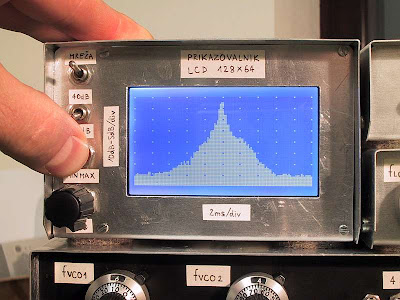
    PIC LCD Oscilloscope for Spectrum Analyzers

    PIC LCD Oscilloscope for Spectrum Analyzers
    This is simple and inexpensive LCD oscilloscope for spectrum analyzer display. The project use PIC 16F876A as main processor. Although a small LCD screen is not as good as analog oscilloscope, a LCD oscilloscope may be very useful in field measurements, for battery operation or you need different measurement at the same time along with oscilloscope.

    The 80dB scale of this LCD oscilloscope can be adjusted with the two trimmers providing the reference voltages to the A/D converter. The operation of the LCD oscilloscope is slightly different between the 80dB mode and the 40dB mode. In the 80dB mode, the trace is always visible and saturates on the bottom or top of screen. In the 40dB mode, the trace runs out of the screen and only the central part of the original 80dB scale is displayed. This project designed by Matjaz Vidmar.

    Download
    Source code, documentation and schematic

    tags : LCD, Oscilloscope, Spectrum Analyzer, PIC, microcontroller, project src

    PIC LCD Oscilloscope for Spectrum Analyzers

    PIC LCD Oscilloscope for Spectrum Analyzers
    This is simple and inexpensive LCD oscilloscope for spectrum analyzer display. The project use PIC 16F876A as main processor. Although a small LCD screen is not as good as analog oscilloscope, a LCD oscilloscope may be very useful in field measurements, for battery operation or you need different measurement at the same time along with oscilloscope.

    The 80dB scale of this LCD oscilloscope can be adjusted with the two trimmers providing the reference voltages to the A/D converter. The operation of the LCD oscilloscope is slightly different between the 80dB mode and the 40dB mode. In the 80dB mode, the trace is always visible and saturates on the bottom or top of screen. In the 40dB mode, the trace runs out of the screen and only the central part of the original 80dB scale is displayed. This project designed by Matjaz Vidmar.

    Download
    Source code, documentation and schematic

    tags : LCD, Oscilloscope, Spectrum Analyzer, PIC, microcontroller, project src

    PIC LCD Oscilloscope for Spectrum Analyzers

    PIC LCD Oscilloscope for Spectrum Analyzers
    This is simple and inexpensive LCD oscilloscope for spectrum analyzer display. The project use PIC 16F876A as main processor. Although a small LCD screen is not as good as analog oscilloscope, a LCD oscilloscope may be very useful in field measurements, for battery operation or you need different measurement at the same time along with oscilloscope.

    The 80dB scale of this LCD oscilloscope can be adjusted with the two trimmers providing the reference voltages to the A/D converter. The operation of the LCD oscilloscope is slightly different between the 80dB mode and the 40dB mode. In the 80dB mode, the trace is always visible and saturates on the bottom or top of screen. In the 40dB mode, the trace runs out of the screen and only the central part of the original 80dB scale is displayed. This project designed by Matjaz Vidmar.

    Download
    Source code, documentation and schematic

    tags : LCD, Oscilloscope, Spectrum Analyzer, PIC, microcontroller, project src