Showing posts with label PIC. Show all posts

Tuesday, June 22, 2010

PIC based Animation Tile Display

PIC based Animation Tile Display, Display, LED, project, PIC, PIC24FJ64GA002, animation, puzzle
Puzzlemation is an expandable platform of light and animation based on PIC24FJ64GA002. It can be used to create things as diverse as modular animated signs that can be changed by rearranging its tiles, to a uniquely animated puzzle. This project’s display is made of a number of tiles, about 2 inch square with an 8 x 8 array of color LED pixels. Each tile is individually powered and animated, so user can freely pick them up and re-arrange them. To set up a display, the tiles are placed in a special tray. Animations are downloaded into the tray via Ethernet and stored locally on an EEPROM, or loaded via an SD card. The tray broadcasts the animation to each of the tiles, and then synchronizes them.

John Peterson, project designer, said that the display is completely reconfigurable. If the pieces are left in the tray, the animation can be updated continuously over the Ethernet connection. If the tiles are removed from the tray, they’ll display the animation for several hours with their own re-chargeable battery power. Once the animation is synchronized and running on the tiles, user can pick them up and place them anywhere.

Download:
Project Documentation, Source Code and Schematic(zip)
tag :
Display, LED, project, PIC, PIC24FJ64GA002, animation, puzzle

Thursday, September 17, 2009

Simple PIC RF/Microwave Frequency Counter

PIC RF/Microwave Frequency Counter
This RF/Microwave Frequency Counter project built based on PIC 16F876A. The basic counter rate is extended to at least 180MHz using two 74Fxx devices. A divide-by-64 prescaler is used for higher frequencies up to at least 4.5GHz. All results of the measurement are shown on an inexpensive, 2x16 alphanumeric LCD module with large characters.

There are 3 inpust on this project a microwave (prescaled) input, an RF input and a TTL input. The microwave and RF inputs are AC coupled and terminated to a low impedance (around 50ohms). The TTL input is DC coupled and has a high input impedance. A progress-bar indicator is provided on the LCD for the gate timing.

Both the microwave and RF inputs have an additional feature : a simple signal-level detector driving yet another bar indicator on the LCD module. This is very useful to check for the correct input-signal level as well as an indicator for circuit tuning or absorption-wave-meter dip display (Lecher wires). This project designed by Matjaz Vidmar.

tag : RF counter, Microwave Frequency counter, PIC project source

Simple PIC RF/Microwave Frequency Counter

PIC RF/Microwave Frequency Counter
This RF/Microwave Frequency Counter project built based on PIC 16F876A. The basic counter rate is extended to at least 180MHz using two 74Fxx devices. A divide-by-64 prescaler is used for higher frequencies up to at least 4.5GHz. All results of the measurement are shown on an inexpensive, 2x16 alphanumeric LCD module with large characters.

There are 3 inpust on this project a microwave (prescaled) input, an RF input and a TTL input. The microwave and RF inputs are AC coupled and terminated to a low impedance (around 50ohms). The TTL input is DC coupled and has a high input impedance. A progress-bar indicator is provided on the LCD for the gate timing.

Both the microwave and RF inputs have an additional feature : a simple signal-level detector driving yet another bar indicator on the LCD module. This is very useful to check for the correct input-signal level as well as an indicator for circuit tuning or absorption-wave-meter dip display (Lecher wires). This project designed by Matjaz Vidmar.

tag : RF counter, Microwave Frequency counter, PIC project source

Simple PIC RF/Microwave Frequency Counter

PIC RF/Microwave Frequency Counter
This RF/Microwave Frequency Counter project built based on PIC 16F876A. The basic counter rate is extended to at least 180MHz using two 74Fxx devices. A divide-by-64 prescaler is used for higher frequencies up to at least 4.5GHz. All results of the measurement are shown on an inexpensive, 2x16 alphanumeric LCD module with large characters.

There are 3 inpust on this project a microwave (prescaled) input, an RF input and a TTL input. The microwave and RF inputs are AC coupled and terminated to a low impedance (around 50ohms). The TTL input is DC coupled and has a high input impedance. A progress-bar indicator is provided on the LCD for the gate timing.

Both the microwave and RF inputs have an additional feature : a simple signal-level detector driving yet another bar indicator on the LCD module. This is very useful to check for the correct input-signal level as well as an indicator for circuit tuning or absorption-wave-meter dip display (Lecher wires). This project designed by Matjaz Vidmar.

tag : RF counter, Microwave Frequency counter, PIC project source

Sunday, August 2, 2009

PIC Cactus LED Display

LED Cactus Display PIC Project

LEDactus is LED display project that resemble Cactus. It used PIC microcontroller 18F1320 as controller of the LED. LEDactus is immobile and attempts to survive by creating a pleasant display. It can produce more complex and mesmerizing displays. And in the latest generations, a sense of touch is added to allow the LEDactus to interact with passersby.

term : LED display, electronic cactus, PIC project (src)

PIC Cactus LED Display

LED Cactus Display PIC Project

LEDactus is LED display project that resemble Cactus. It used PIC microcontroller 18F1320 as controller of the LED. LEDactus is immobile and attempts to survive by creating a pleasant display. It can produce more complex and mesmerizing displays. And in the latest generations, a sense of touch is added to allow the LEDactus to interact with passersby.

term : LED display, electronic cactus, PIC project (src)

PIC Cactus LED Display

LED Cactus Display PIC Project

LEDactus is LED display project that resemble Cactus. It used PIC microcontroller 18F1320 as controller of the LED. LEDactus is immobile and attempts to survive by creating a pleasant display. It can produce more complex and mesmerizing displays. And in the latest generations, a sense of touch is added to allow the LEDactus to interact with passersby.

term : LED display, electronic cactus, PIC project (src)

Tuesday, June 30, 2009

PIC LCD Oscilloscope for Spectrum Analyzers

PIC LCD Oscilloscope for Spectrum Analyzers
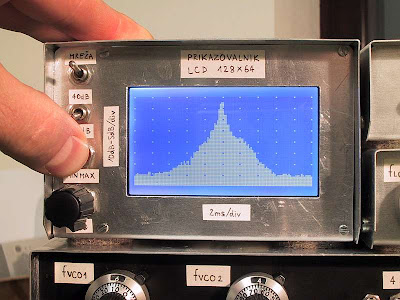
This is simple and inexpensive LCD oscilloscope for spectrum analyzer display. The project use PIC 16F876A as main processor. Although a small LCD screen is not as good as analog oscilloscope, a LCD oscilloscope may be very useful in field measurements, for battery operation or you need different measurement at the same time along with oscilloscope.

The 80dB scale of this LCD oscilloscope can be adjusted with the two trimmers providing the reference voltages to the A/D converter. The operation of the LCD oscilloscope is slightly different between the 80dB mode and the 40dB mode. In the 80dB mode, the trace is always visible and saturates on the bottom or top of screen. In the 40dB mode, the trace runs out of the screen and only the central part of the original 80dB scale is displayed. This project designed by Matjaz Vidmar.

Download
Source code, documentation and schematic

tags : LCD, Oscilloscope, Spectrum Analyzer, PIC, microcontroller, project src

PIC LCD Oscilloscope for Spectrum Analyzers

PIC LCD Oscilloscope for Spectrum Analyzers
This is simple and inexpensive LCD oscilloscope for spectrum analyzer display. The project use PIC 16F876A as main processor. Although a small LCD screen is not as good as analog oscilloscope, a LCD oscilloscope may be very useful in field measurements, for battery operation or you need different measurement at the same time along with oscilloscope.

The 80dB scale of this LCD oscilloscope can be adjusted with the two trimmers providing the reference voltages to the A/D converter. The operation of the LCD oscilloscope is slightly different between the 80dB mode and the 40dB mode. In the 80dB mode, the trace is always visible and saturates on the bottom or top of screen. In the 40dB mode, the trace runs out of the screen and only the central part of the original 80dB scale is displayed. This project designed by Matjaz Vidmar.

Download
Source code, documentation and schematic

tags : LCD, Oscilloscope, Spectrum Analyzer, PIC, microcontroller, project src

PIC LCD Oscilloscope for Spectrum Analyzers

PIC LCD Oscilloscope for Spectrum Analyzers
This is simple and inexpensive LCD oscilloscope for spectrum analyzer display. The project use PIC 16F876A as main processor. Although a small LCD screen is not as good as analog oscilloscope, a LCD oscilloscope may be very useful in field measurements, for battery operation or you need different measurement at the same time along with oscilloscope.

The 80dB scale of this LCD oscilloscope can be adjusted with the two trimmers providing the reference voltages to the A/D converter. The operation of the LCD oscilloscope is slightly different between the 80dB mode and the 40dB mode. In the 80dB mode, the trace is always visible and saturates on the bottom or top of screen. In the 40dB mode, the trace runs out of the screen and only the central part of the original 80dB scale is displayed. This project designed by Matjaz Vidmar.

Download
Source code, documentation and schematic

tags : LCD, Oscilloscope, Spectrum Analyzer, PIC, microcontroller, project src

Wednesday, June 24, 2009

USB PIC Programmer

open source USB PIC Programmer

If you start learning PIC microcontroller, you need PIC progrmmer to "fill" your PIC with compiled source code. You can build your own PIC programmer like USBPICprog project.

Usbpicprog is an USB in circuit programmer for Microchip PIC processors. The hardware is as simple. The latest version only contains one PIC18F2550, 3 mosfets, and besides the connectors a hand full of passive components.

download
Open source programmer


USB PIC Programmer

open source USB PIC Programmer

If you start learning PIC microcontroller, you need PIC progrmmer to "fill" your PIC with compiled source code. You can build your own PIC programmer like USBPICprog project.

Usbpicprog is an USB in circuit programmer for Microchip PIC processors. The hardware is as simple. The latest version only contains one PIC18F2550, 3 mosfets, and besides the connectors a hand full of passive components.

download
Open source programmer


USB PIC Programmer

open source USB PIC Programmer

If you start learning PIC microcontroller, you need PIC progrmmer to "fill" your PIC with compiled source code. You can build your own PIC programmer like USBPICprog project.

Usbpicprog is an USB in circuit programmer for Microchip PIC processors. The hardware is as simple. The latest version only contains one PIC18F2550, 3 mosfets, and besides the connectors a hand full of passive components.

download
Open source programmer


Sunday, June 14, 2009

PIC Low Cost USB-CAN Distributed Motion Control System

PIC Distributed Motion Control System
This project presents high performance distributed motion control system at extremely low cost. Rapid prototyping of multi-axis designs is often required during the development of automation equipment. One can use centralized controls with PC motion control cards, external amplifiers, and a tangle of wires, or utilize existing high cost distributed motion control system with RS485, Ethernet, or one of the fieldbuses (DeviceNet, CANOpen, Profibus, etc.). With the use of highly integrated microcontrollers, such as the PIC18FXX8, and power devices like the Allegro A3977/A3959, a very small and inexpensive system was developed.

Download
document and schematic

tag : motion control system, USB, PIC project src

PIC Low Cost USB-CAN Distributed Motion Control System

PIC Distributed Motion Control System
This project presents high performance distributed motion control system at extremely low cost. Rapid prototyping of multi-axis designs is often required during the development of automation equipment. One can use centralized controls with PC motion control cards, external amplifiers, and a tangle of wires, or utilize existing high cost distributed motion control system with RS485, Ethernet, or one of the fieldbuses (DeviceNet, CANOpen, Profibus, etc.). With the use of highly integrated microcontrollers, such as the PIC18FXX8, and power devices like the Allegro A3977/A3959, a very small and inexpensive system was developed.

Download
document and schematic

tag : motion control system, USB, PIC project src

PIC Low Cost USB-CAN Distributed Motion Control System

PIC Distributed Motion Control System
This project presents high performance distributed motion control system at extremely low cost. Rapid prototyping of multi-axis designs is often required during the development of automation equipment. One can use centralized controls with PC motion control cards, external amplifiers, and a tangle of wires, or utilize existing high cost distributed motion control system with RS485, Ethernet, or one of the fieldbuses (DeviceNet, CANOpen, Profibus, etc.). With the use of highly integrated microcontrollers, such as the PIC18FXX8, and power devices like the Allegro A3977/A3959, a very small and inexpensive system was developed.

Download
document and schematic

tag : motion control system, USB, PIC project src

Tuesday, May 12, 2009

PICTalker - Low Cost PIC Speech Synthesizer

PICTalker
PICTalker is a low cost allophone-based system for synthesis speech. The system use PIC16F628 microcontroller as main processor. You need a PIC development system and programmer, and Microsoft QBasic to program the microcontroller and EEPROMs to build this poject.

Speech quality is somewhat inferior to that from an SPO256 system. Most people immediately understand most or all of the speech it produces provided sufficient care is taken when constructing words from the component allophones. The speech is significantly easier to understand if the loudspeaker used has poor base response.

Download
Documentation and source code

tag : low cost speech synthesizer, PIC project (src)

PICTalker - Low Cost PIC Speech Synthesizer

PICTalker
PICTalker is a low cost allophone-based system for synthesis speech. The system use PIC16F628 microcontroller as main processor. You need a PIC development system and programmer, and Microsoft QBasic to program the microcontroller and EEPROMs to build this poject.

Speech quality is somewhat inferior to that from an SPO256 system. Most people immediately understand most or all of the speech it produces provided sufficient care is taken when constructing words from the component allophones. The speech is significantly easier to understand if the loudspeaker used has poor base response.

Download
Documentation and source code

tag : low cost speech synthesizer, PIC project (src)

PICTalker - Low Cost PIC Speech Synthesizer

PICTalker
PICTalker is a low cost allophone-based system for synthesis speech. The system use PIC16F628 microcontroller as main processor. You need a PIC development system and programmer, and Microsoft QBasic to program the microcontroller and EEPROMs to build this poject.

Speech quality is somewhat inferior to that from an SPO256 system. Most people immediately understand most or all of the speech it produces provided sufficient care is taken when constructing words from the component allophones. The speech is significantly easier to understand if the loudspeaker used has poor base response.

Download
Documentation and source code

tag : low cost speech synthesizer, PIC project (src)

Thursday, April 23, 2009

Digital Clock using Classic LED 7 Segment Displays

Simple digital clock PIC project

This is a simple digital clock project using PIC16F887 and classic LED 7-Segment from HP 5082-7414 created by punkky. The displays are bright red and sun light viewable. Each clock consumes about 0.25W (50mA, 5V) when the PIC16F887 operates at 250kHz (display refresh rate is about 61Hz).

Tag: digital clock, 7 segment display, PIC project src